Category Archives: Uncategorized

Part IX

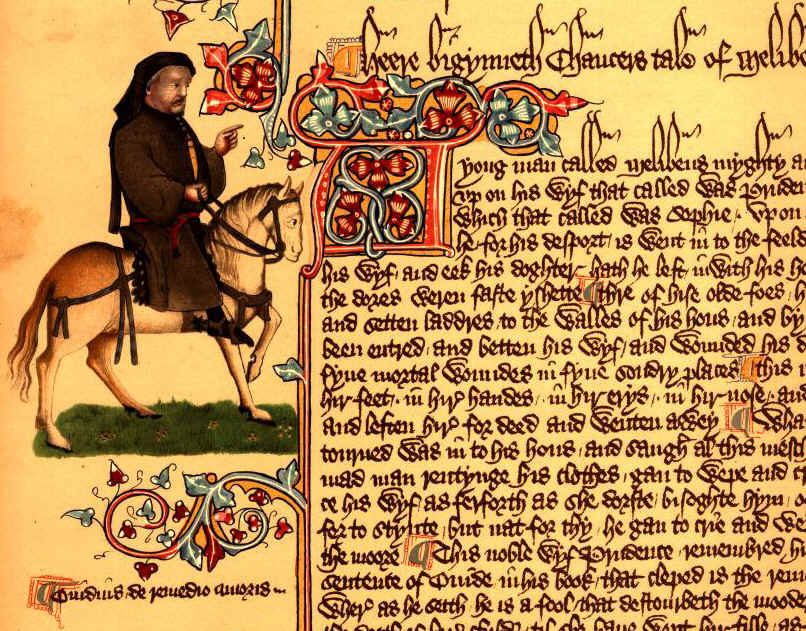
ChaucerPortraitEllesmereMs

At the end of the last section of this project I proposed certain changes to tale ordering in which I split up Fragment VII into two parts, dividing the six tales into separate groupings to better accommodate their internal contexts and physical clues within various manuscripts. I will briefly skip Fragment VIII, and look at Fragment IX containing the Manciple’s Prologue and Tale instead.

The first clue to deciphering the Manciple’s order within the Tales is actually found in the Parson’s Prologue of Fragment X. In Hengwrt, at the beginning of the Parson’s Prologue where it is announced that “By that the Mauciple hadde his tale al ended,” the word “Mauciple” was written over an erasure. Further, the ink used for the Manciple’s Tale was from a different batch altogether, as it yellowed differently from the ink in Fragment X. In other words, it was added much later.  The main argument against claiming the Manciple’s Tale is out of place, however, has to do with the ink type of the actual word “Manciple” as it appears in the Parson’s Prologue; while it was written over erasure, the ink did not yellow in the same way as the tale, leading many to believe that it was not an inserted afterthought but rather originally planned. This is very possible, but my opinion is that any original planning was on the part of the scribe, as the movement of the Manciple’s Tale will be traced. First, the Parson’s Prologue and Tale are incredibly long making it not unlikely, or unreasonable, that he would have to go back and mix more ink for another tale. Then it must be noted that the Manciple’s piece is written in the same ink as the Nun Priest’s Tale.

Before any more connections can be made, it is important to focus on the erased word. Why is there an erased word with “Mauciple” written over? There was another tale that needed to go before the Parson’s Prologue, but the Hengwrt scribe did not have it. He edited out the other teller’s name and put in “Mauciple,” realizing that the Manciple from earlier would now be more fitting. To better understand this argument, the Hengrwrt needs to be taken into consideration. The Manciple’s Prologue and Tale were written already, halfway through the manuscript. However, just as the scribe found several other editorial mistakes he corrected when later compiling the Ellesmere, here, too, he makes a note for moving the Manciple’s Tale down, and consequently the previous tales along with it (Fragment VII and Fragment VIII that have not yet been discussed). The reasoning for this is rather simple: references to location. This is not to give too much credence to the Bradshaw Shift, but it does appear that throughout Fragments VIII and IX the pilgrims are drawing much more closer to Canterbury than they had yet been, meaning these two fragments needed to be near the end rather than the middle. In the Manciple’s Prologue the pilgrims come to “a litel town / which y clepid is Bobbe upanddown / under the Blee” while in the Canon Yeoman’s Prologue they are at “Boghtou under Blee.” I am intentionally ignoring any arguments made in favor of certain tales being reserved for a return trip since so little evidence exists that most of those arguments are deepest rooted within the writers’ ambitions. However, what I would like to propose is switching Fragments VIII and IX. While the scribe was correct in moving these fragments down the ordering sequence and keeping them together, he reversed their order.

It appears that after the scribe realized he was at the end and that the Manciple’s Tale should have been inserted closer to the Parson’s Tale and subsequent Retraction, he moved the Manciple’s Tale and Fragment VII down because they had originally been written in one continuous strip (recall the inks used to complete the Nun’s Priest’s Tale and the Manciple’s Prologue were the same). Yet what becomes immediately noticeable when looking from the Hengwrt to the Ellesmere is the addition of several tales. At some point in between creating these two manuscripts more tales became available, and the scribe used his knowledge of the tales already in his possession to find the best place for the new ones. Some were quite obvious while others were only superficially so. One such late tale is the Canon’s Yeoman’s Tale that is not included in earlier manuscripts, and no mention of the Canon or Yeoman is made in the General Prologue, meaning that the characters were an afterthought, or appropriated from a different project Chaucer may have been working on, deciding they would be better suited in the Tales (not the first time he had done this).

Once the Second Nun’s  and Canon’s Yeoman’s Prologues and tales came to light, due to the geographical reference in the latter’s tale, the entire fragment was linked with the Manciple’s fragment. Just like those who discredit Bradshaw for forming entire chains of tales according to a few sparse geographical references that could have easily been edited out later, here the connection does not rely solely on these place names, nor does my argument for reversing the fragments, but rather treats them as markers for further analysis. When the scribe decided that Fragment VIII should precede Fragment IX, it was not only done because he had already written “Mauciple” in the following fragment in the prototype manuscript, and did not want to renege on his original editing. On the surface it appeared that the Second Nun should follow the Nun’s Priest, especially since both tales are concerned with various natures of morality, as is the Canon’s Yeoman’s Tale. Yet this is a most superficial reading, and further, it leaves the Manciple’s Tale oddly out because it is then followed by the Parson’s Tale that preaches many of the same values found in tales from Fragment VIII. Therefore, while I do not dispute that they should be closely kept together in light of the geographical mention, a better reason to keep them together is found within the text, but for different reasons than the scribe may have had.

Just as we saw in (what I refer to as the Second Trio) Fragment VII, the imagery of the pearl from the Prioresse’s Tale being carried forward in the Tale of Sir Thopas (topaz), here, in placing Fragment IX before Fragment VIII, the bird imagery of Chauntecleer is echoed by the white crow in the Manciple’s Tale. Moreover, the two tales seem to play off each other as the Nun’s Priest’s Tale is beautifully told (often considered one of Chaucer’s best works), while the Manciple’s bird story takes a piece of Ovid’s Metamorphosis and inundates it with over the top allusions and unnecessary narration. Both have a moral at the end, but while the Nun’s Priest’s Tale warns the audience against hubris, the Manciple’s has more worldly concerns, namely knowing when to keep one’s mouth shut (albeit an important lesson that would benefit many). In a more stylized fashion, the Second Nun’s Tale would then follow these two, conflating the several themes from the Nun’s Priest’s and Manciple’s Tales.

Chastity is celebrated throughout the tale of St. Cecilia as told by the Second Nun, and a virtue that directly contrasts the wife in the Manciple’s Tale who was equally as worshiped by her husband but was nevertheless unfaithful to him. While both women die for their vices and/or virtues, their deaths are intricately tied to singing – the wife in the Manciple’s Tale is murdered by her husband after the white crow sings of her infidelity, and Cecilia sings for three days until death. Both forms of singing are equatable to truth telling as the crow uncovers the truth behind the wife’s affair, and Cecilia sings of the truth of Christianity, converting as many as she can in her final hours (highly reminiscent of the Prioresse’s Tale). Yet while singing serves to tie these tales, and also the Nun’s Priest’s Tale together, the motives behind the singing vary. If one recalls Chauntecleer, he sang out of hubris to hear his own golden voice and proudly display it for others. The white crow seems to have no motives, repeating what it saw simply because it can. While on the opposite side of the spectrum, Cecilia sings altruistically for the benefit of others.

A final link that ties the Second Nun’s Tale to the Canon’s Yeoman’s Tale, solidifying the unity of this fragment (and further strengthened by the fact that less than a handful of manuscripts ever separate the two), relies on an interpretation of Cecilia in which she represents Heaven and simultaneously acts as the converter of souls. To make this argument as straightforward as possible, she converts base pagan souls into golden Christian ones, which leads into the Canon’s Yeoman’s Tale describing the debasement he experienced within the field of alchemy, a craft dedicated to converting base metals like lead, into silver and gold. The alchemist in the tale is the epitome of avarice and pride, which is a far better tale to directly precede the Parson who will be concerned with enumerating the seven deadly sins along with the act of penance, as opposed to the Manciple’s Tale that is arguably just a retelling of the Merchant’s Tale if it were turned into a tragedy. In short, it is far more likely that the Canon’s Yeoman’s Tale would have sparked the Parson’s somber mood and consequent tale right before the end.

Thus while the obvious, immediate disparities within physical manuscripts and narratives provide important information, they are best used as guides for further analysis. After having conducted just that, here is the resulting sequence of tales (including those discussed last time):

Fragments 1-5 (as depicted in Ellesmere and most other authoritative manuscripts) ending with the Franklin’s Tale

Fragment VII(second trio) – Prioresse-Thopas-Melibee

Fragment VI- Physician-Pardoner

Fragment VII(first trio) – Shipman-Monk-Nun’s Priest

Fragment IX – Manciple

Fragment VIII – Second Nun-Canon’s Yeoman

Once again, the ordering in previous fragments has not been effected, but the flow of tales has been improved. Next time I want to explore the The Tale of Gamelyn, a curious little tale that weaves its way in and out of manuscripts, and consequently challenging its own authenticity and place within the tale sequence.


Practical

I bought a new dress (venus.com) because, well, why not? And since I have no plans of going out soon this seems like  a very practical purchase. I can wear it while feeding the cats and cooking dinner for the kids….

black dress


It is very shiny, so I am sure both cats and small children will be mesmerized. It will also come in handy on laundry days. What, you have never seen a woman in a sequins dress grocery shopping?

Or I can just hang it in my closet next to all the other dresses I haven’t yet worn.

Since my commenting section won’t let me put up all the pictures, in response to the comment below, here is a list of other dresses I bought from them:

I bought this one as a work dress. Even though it has been warm, when I leave in the morning it is still dark and cold, so I have not worn it yet…

red dress


I bought this in December. Wore it once to a Christmas party. I only have a picture of the hem of it as I am sitting in the car….


faux leather dress             hem


Bought this one around the same time… never wore it…

black dress


This is the first dress I ever got from them, sort of like a tester to see what their sizing is like… Wore it once… and provided evidence that I need a tan and a blow dryer…

grey dress             grey dress1


Bought this one back in December too… have never worn it…

darkgreydress


So you see, unless I start having personal fashion shows in the kitchen, these dresses will not get a whole lot of use… even the ones I have worn only got used for a few hours…

Musical Metafiction?

bonnie-raitt

If you happen to have looked at my blog this weekend, you know I was on a mini vacation. While there, I found (not really found since I knew it was there from last time) a used CD store. It is kind of like Amoeba in LA, but not as big, and seems to specialize in classic rock, which was exactly what I was looking for. Many of my old CDs have gotten scratched up, and even more albums I have never replaced after tapes became obsolete. I have now replenished my Billy Joel collection (another blog post altogether), found a few other things I was missing, and bought Bonnie Raitt’s Nick of Time album. I haven’t listened to it in about twenty years, and despite it being one of my favorite tapes on repeat for the better part of the early 90’s (yes, I was playing stuff on repeat then too), after the tape broke circa 1994 I never did anything about it. For as much as I loved Bonnie, I sadly threw the tape away almost as if it never occurred to me that I could get another one.

There have been several times I ran into her old albums when CD stores still existed, but I always passed them up. First, I was kind of anti CDs for a little while. I had 200+ tapes, and I staunchly protested giving them up. CD players had been around for a while, but I didn’t have one, so as far as I was concerned they were potentially dangerous magical instruments. While tape players worked on the principles of magnets (tangible concepts I could understand), the CD player had a weird glass eye staring at you. No thank you.

I finally broke down and asked for a CD player for my 17th birthday. My first CD was Soundgarden’s Superunknown, followed by Marilyn Manson’s Antichrist Superstar, and The Best of Blondie. I didn’t buy another CD until half my tapes were falling apart and my tape player eventually died. I am not counting any of S’s CDs since he was even more anti-CD than I was, and his collection for the longest time expanded no further than Nirvana and a few other 90’s iconic bands. His tape collection, however, shamed mine. He also kept his tapes in far better condition (probably because he didn’t continuously rewind them with his little finger in attempts to hear the same song over and over again ad infinitum). But a dead tape player still meant that we were both done. And just like with the Bonnie Raitt album years earlier, for whatever reason I sadly got rid of the player never considering that we could get a new one. Slowly but surely the CD conversion began (and is very much still not finished).

This morning I was listening to Bonnie Raitt while driving. How appropriate. My fascination with Nick of Time started shortly before I moved to California. It was 1990 and the album had just come out less than a year before. One of our neighbors was moving. She was having coffee with my mom in our living room when she told me she had a bunch of tapes she thought I would like (she may have gotten tired of hearing Madonna through the walls). Bonnie Raitt was mixed in a decent sized box with Creedence Clearwater, Morrissey, the Smiths and many more, solidifying my appeal for 80’s music. Not long afterwards it was our turn to move, and as my parents drove us from New York to California in a Dodge Something-or-other I was insistent that I only wanted to hear Bonnie Raitt. My mother didn’t exactly dislike the album, and considering that it was either Bonnie or static, Nick of Time won.

For almost a week my parents took turns driving day and night (and the $900 Dodge Something-or-other they bought in New Jersey died only a few weeks after making it to California). During waking hours (a description that varied from one day to the next since someone was always awake) Bonnie could be heard in the car, which I take to be less of an indication of my love for her music as a reflection of my parents’ patience for me. We arrived in LA mid July, and by December Bonnie was mixed in with the other favorites while another band took the “absolute favorite” spot. And just like all the other favorites, over the years she emerged again and again to be replayed until shuffled back. Then the tape died and  her songs became only memories attached to specific parts of my life (and I still remember every single word from that album). Occasionally the radio would play her, but never the really good songs, just the popular ones like “Let’s Give Them Something to Talk About,” that is good, and catchy, but not great. The best definition I would have for that song is “cutesy” which is not to say I don’t enjoy singing along to it, or that I don’t turn the radio up when it comes on, but it doesn’t get me to ask questions or even think very much. Again, not a bad thing – there are plenty of songs I love simply because they sound good, even as their lyrics are asinine or unintelligible. But songs like “Nobody’s Girl” never made it on the top 40’s lists.

As I was listening to the CD today the songs took on a different meaning for me (as such things often do with time), and I was no longer a child (or later a young girl) mesmerized by the passion in her voice, but a woman analyzing her lyrics, and reading into them in ways Bonnie probably never intended. One part from “Love Letter” specifically stood out.

Part of the song:

Sittin’ in front of your house,
Like rain in early dawn
Workin’ on a love letter
Got my radio on.

Got my eye on your window pane
And I smoked a lot of cigarettes.
Mercy, mercy but love is strange
And you haven’t even kissed me yet.

Look comes to push,
Push comes to shove,
Shove comes to touch,
Touch will come to love.

Workin’ on a love letter,
Listenin’ to a love song,
I’m writing you a love letter, love letter,
Got my radio on…

Hope you get the message baby.
I know that you’re gonna let me in.
It’s real in your neighborhood
And this is more than I’m gonna bend.

I couldn’t help but wonder if Bonnie (Bonnie Hayes, not Bonnie Raitt actually wrote the lyrics) was amused by writing a love song in which Bonnie will be  singing about writing a love letter while listening to a love song. In the world of this song, do other love songs exist? Is the first person narrator, who is presumably sitting outside this man’s house in a car, aware of her existence within a song? Or is the song simply a narrative of an event and we are supposed to ignore these implications (as I am highly suspicious that this is in fact the case)?

None of this occurred to me the first bajillion times I heard these lyrics. It was always just an upbeat enjoyable love song (despite its creepy stalkerish implications reminiscent of  the Police’s “Every Breath You Take,” but not as bad as Morrissey’s later “The More You Ignore Me, the Closer I Get”). But today, the song, at least for me, entered the realm of metafiction, existing in a limbo between self awareness and refusal to acknowledge itself as she continued on about the man’s neighborhood in the vocal equivalent of a scene in a dark comedy where the actors are watching Burn After Reading, blatantly ignoring the parallels within their own existence.

Yet this song begs for parallels to be drawn. Nowhere does it mention what love song she is listening to, leaving the listener to fill in the blanks. What contemporary (or older) love song on the radio could have acted as her inspiration? Was it simply inspiration for her make-believe love letter, or did it influence the entirety of her song? Or was it just the idea of such a song even existing that sparked everything? Could it be that this song would later serve to influence future love letters? None of these questions really have answers because any answer would suffice. Both Bonnie Raitt and Hayes have done numerous interviews mentioning this song, with nothing more said about it other than lauding its success. Which I suppose speaks to the fact that it probably did inspire love letters (for better or worse) – an argument that can be made for almost every song ever written, as surely somewhere someone is listening to Slayer’s “Angel of Death” and carving their sweetheart’s name into the side of their arm.

However, in “Love Letter” the metacognition is muted by the immediacy of the lyrics where the action is taking place in the now, and every love song that could possibly be playing in the background of this song flashes by as we move on to the next part of the narrative, only to be reminded of it again in even vaguer terms; a “love song” specifically turns into “radio” that could be anything. If the inspiration for those lines was in fact another love song, that information never became public knowledge. Basically whether Hayes liked listening to The Bangles’ “Eternal Flame” (that had just come out) while writing “Love Letter” and inserted it into the inner background of the song’s imagery to draw some sort of possible comparison (yet to be determined) is just as likely as any of the assumptions made about Mitchell’s Cloud Atlas. And just like Mitchell’s overt use of the style, I like to think Bonnie (Hayes and Raitt) “hope you get the message.” And maybe chuckled at it a bit.